
EU–India “Mother of All Deals” Reshaping Customs and Global Value Chains
- Ramiro Morales
- Jan 29
- 4 min read

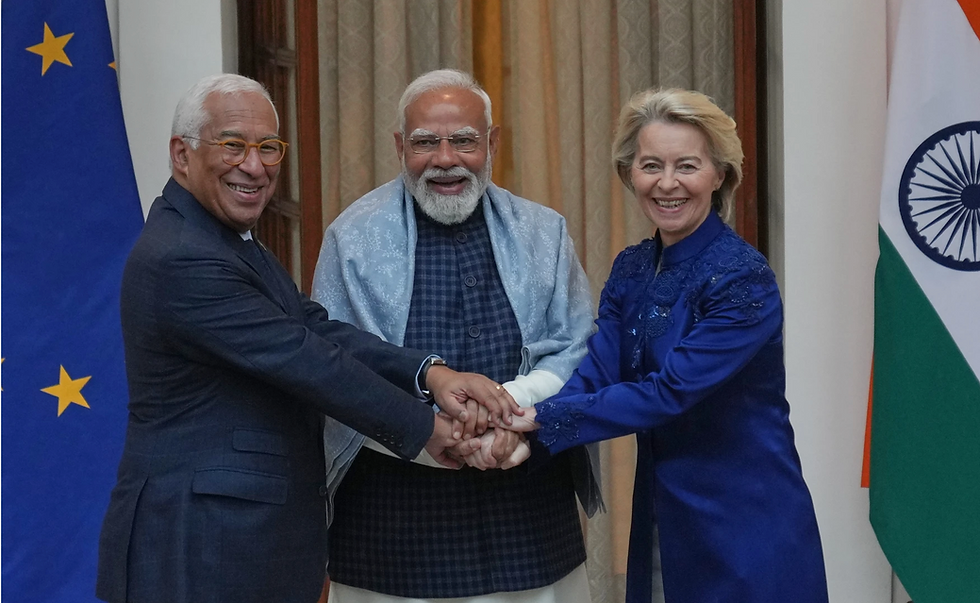
On 27 January 2026, the European Union and India concluded negotiations on a landmark Free Trade Agreement (FTA), publicly characterized as the “mother of all deals.” The agreement represents the largest free trade arrangement ever concluded by either party and marks a decisive shift toward a rules-based, strategic economic partnership. Its relevance for businesses is immediate and concrete, particularly in the areas of customs liberalisation, rules of origin, and global value chain structuring, all of which directly affect cross-border trade costs and compliance obligations.
Market Access, Tariff Liberalisation, and Rules of Origin
The FTA establishes extensive tariff elimination and phased reductions across a vast majority of tariff lines on both sides. India secures preferential access to the European market for almost all of its exports by trade value, while European exporters benefit from the most ambitious tariff concessions India has ever granted to a trading partner. The regulatory architecture is designed to create predictability and legal certainty, enabling businesses to plan long-term investments and integrate more deeply into bilateral and global value chains.
From a customs standpoint, a central pillar of the agreement is the introduction of product-specific rules of origin. These rules require sufficient processing or substantial transformation to confer originating status, while allowing calibrated flexibility to source inputs from global supply chains. The agreement further simplifies compliance through self-certification mechanisms, reducing administrative burdens, clearance times, and costs, particularly for small and medium-sized enterprises.
Implications for Businesses – Customs Benefits, Country of Origin, and Transfer Pricing/VCA Coherence
For businesses importing goods into the European Union, the designation of India as the country of origin under the FTA can generate significant customs advantages. Where origin requirements are met and properly documented, imports may benefit from reduced or zero customs duties, directly lowering landed costs and improving pricing and margin flexibility. This is especially relevant for product categories that were previously subject to moderate to high EU import duties.
The agreement also has important implications for transfer pricing and value chain analysis. Preferential origin treatment is inherently linked to where value-creating activities occur within the supply chain. As a result, multinational enterprises must ensure coherence between their operational reality, their customs origin claims, and their transfer pricing policies. In practice, this may require reassessing functional profiles, intercompany pricing arrangements, and contractual allocations of risks and responsibilities, so that customs valuation, origin determination, and OECD-aligned transfer pricing outcomes remain consistent and defensible. In the short term, businesses should prioritise origin qualification assessments, supply chain mapping, and documentation readiness. In the medium to long term, the FTA creates strategic opportunities to restructure sourcing, manufacturing, and distribution models to optimize customs duty exposure while maintaining robust tax and regulatory compliance.
Sector-Specific Benefits – Including Iron and Steel and Pharmaceuticals
The sectoral impact of the agreement is broad and extends beyond traditional labour intensive industries. Manufacturing-driven sectors such as engineering goods, chemicals, plastics, and rubber benefit from enhanced market access and tariff elimination, strengthening their competitive positioning in the European market. Importantly, iron and steel-related value chains are also addressed through structured liberalisation mechanisms, including preferential access and tariff-rate quotas for certain steel products. For qualifying exporters, this can translate into reduced duty burdens and improved predictability, while downstream manufacturers may benefit indirectly through more stable and cost-efficient input sourcing.
Pharmaceuticals and life sciences represent another strategically important area. Tariff reductions on pharmaceutical products and medical devices improve competitiveness and facilitate cross-border trade in regulated, high-value goods. Beyond duty savings, the agreement enhances predictability and efficiency at the border, which is critical for time-sensitive products subject to strict regulatory and quality controls.
Product | 2024 exports (EUR) | Current tariffs | Future tariffs |
Machinery and electrical equipment | €16.3 billion | Up to 44% | 0% for almost all products |
Aircraft and spacecraft | €6.4 billion | Up to 11% | 0% for almost all products |
Optical, medical and surgical equipment | €3.4 billion | Up to 27.5% | 0% for 90% of the products |
Plastics | €2.2 billion | Up to 16.5% | 0% for almost all products |
Pearls, precious stones and metals | €2.1 billion | Up to 22.5% | 0% for 20% of the products; tariff reduction for another 36% of the products |
Chemicals | €3.2 billion | Up to 22% | 0% for almost all products |
Motor vehicles | €1.6 billion | 110% | 10% (quota of 250k) |
Iron and steel | €1.5 billion | Up to 22% | 0% for almost all products |
Pharmaceuticals | €1.1 billion | 11% | 0% for almost all products |
How MCORE LAW Can Help – Integrated Customs and Transfer Pricing Advisory
MCORE LAW assists clients in translating the EU–India Free Trade Agreement into measurable commercial and compliance outcomes. We advise on product-by-product origin qualification, tariff classification, and the design of compliant self-certification and documentation frameworks. In parallel, we support the alignment of customs valuation with transfer pricing policies and value chain analyses, ensuring consistency across tax and customs positions. For sectors such as iron and steel, pharmaceuticals, and advanced manufacturing, we provide targeted, sector-specific advisory to help clients capture preferential treatment while managing audit risk and maintaining legal certainty in cross-border operations.
Comments